
Business Messaging: The Complete 2026 Guide for Indian Businesses

Business messaging has become the operating system of modern customer engagement. In 2026, Indian businesses send over 186 billion A2P (Application-to-Person) messages every year — across SMS, WhatsApp, RCS, email, and in-app channels — and that number is accelerating. Every OTP, order confirmation, payment alert, appointment reminder, and marketing campaign travels through a business messaging channel.
Yet most businesses still treat messaging as an afterthought — using outdated tools, a single channel, and no strategy. The result is low delivery rates, poor engagement, and wasted budget.
This guide covers everything you need to know about business messaging in 2026: what it is, every major channel explained and compared, industry use cases, automation strategies, compliance requirements for India, and how to build a messaging stack that actually converts.
TechTo Networks powers business messaging for companies across India — from SMS and WhatsApp to Google RCS — through a single, developer-grade platform. Let's start from the beginning.
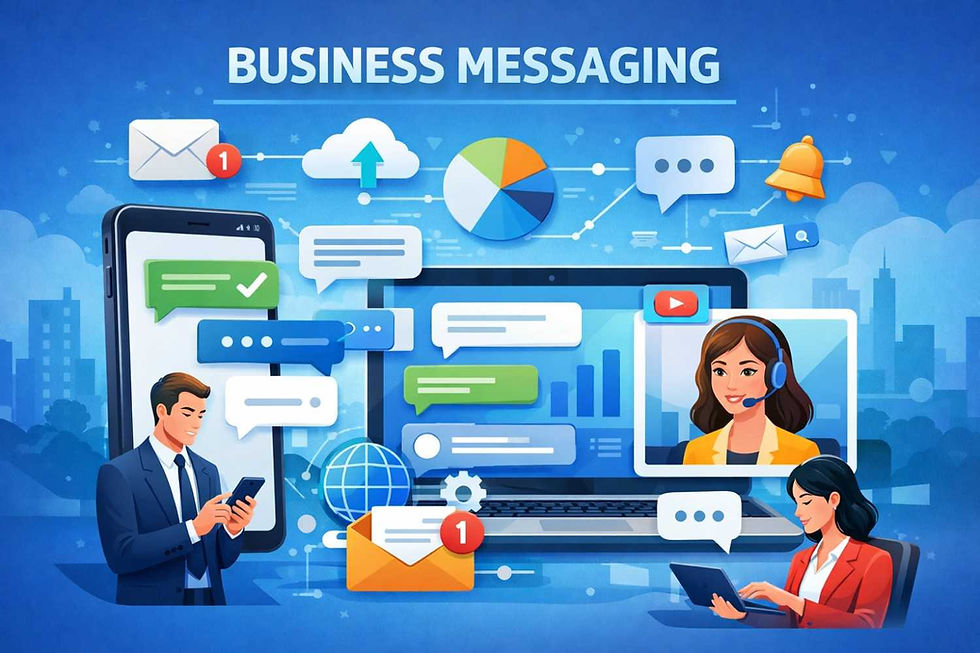
What Is Business Messaging?
Business messaging refers to any structured communication sent from a business to its customers, partners, employees, or systems via a digital messaging channel. It is distinct from personal messaging (P2P — person-to-person) because it flows from an application or platform to a person, which is why it's technically called A2P messaging (Application-to-Person).
Business messaging covers two broad directions:
Outbound (Business → Customer): Notifications, alerts, OTPs, marketing campaigns, appointment reminders, delivery updates, payment receipts, and survey requests.
Inbound / Conversational (Customer ↔ Business): Customer support via chat, product enquiries, booking confirmations, feedback collection, and chatbot-driven self-service flows.
In 2026, the line between the two is increasingly blurred. Modern business messaging platforms allow brands to launch a campaign, receive replies, route conversations to support agents, and close a sale — all within the same messaging thread.
Why Business Messaging Is Non-Negotiable in 2026
The numbers tell a clear story about why businesses are shifting budgets toward messaging:
Metric | Business Messaging | Social Media | |
Average open rate | 94–98% | 20–25% | 5–15% (organic reach) |
Average read time after receipt | < 3 minutes | 6–12 hours | Variable |
Click-through rate (CTR) | 20–35% (WhatsApp) | 2–5% | 0.5–3% |
Delivery reach (no internet needed) | SMS: Yes / WhatsApp: Requires data | Requires internet | Requires internet |
DND bypass (India) | Transactional SMS: Yes | N/A | N/A |
Beyond open rates, messaging delivers three things that other channels struggle with in the Indian market:
Immediacy. A message sent is a message received in seconds. No spam folder. No algorithm deciding who sees it.
Universal reach. SMS reaches every mobile phone in India — 1.1 billion subscribers — regardless of smartphone, operating system, or data connection. WhatsApp reaches 530 million+ monthly active users in India. RCS now covers 500 million+ RCS-enabled Android devices.
Trust and authentication. With DLT-registered Sender IDs, customers see your verified brand name instead of a random number — building recognition and reducing fraud risk.
The 6 Major Business Messaging Channels in 2026
Business messaging is not one channel — it's a family of channels, each with distinct strengths, reach, cost profiles, and best-fit use cases. Here is a complete breakdown of every channel an Indian business needs to understand in 2026.
1. SMS (Short Message Service)
SMS is the bedrock of business messaging. It has been operating for 30+ years and remains the most universally available messaging channel on earth. In India, SMS is regulated by TRAI through the DLT (Distributed Ledger Technology) framework, which mandates registered Sender IDs and pre-approved message templates for all commercial messages.
SMS message types in India:
Promotional SMS: Marketing messages sent to opted-in, non-DND numbers between 9 AM and 9 PM.
Transactional SMS: Service-related messages (OTPs, order confirmations, payment alerts) that bypass DND restrictions and are delivered 24×7.
OTP/2FA SMS: Dedicated high-priority route for one-time passwords, optimised for sub-3-second delivery with multi-operator failover.
Unicode SMS: Messages in Hindi, Punjabi, Marathi, Urdu, and other regional scripts — 70 characters per SMS credit.
Best for: OTP delivery, transactional alerts, mass marketing campaigns, reaching customers without smartphones or data plans, regulated sectors (banking, insurance, healthcare).
Key stats:
98%+ open rate; most messages read within 3 minutes
Works on every mobile phone, 2G/3G/4G/5G, no internet required
TRAI DLT compliance mandatory for all commercial SMS in India since 2021
Cost: ₹0.09 – ₹0.20 per message depending on volume and route
2. WhatsApp Business Messaging
WhatsApp is the dominant messaging app in India with 530 million+ monthly active users as of 2026. The WhatsApp Business API (now part of Meta's Cloud API) allows businesses to send template messages, run marketing campaigns, handle customer support via chatbots and live agents, and build conversational commerce experiences.
Two modes of WhatsApp business communication:
Template Messages (Business-Initiated): Pre-approved message templates sent proactively to opted-in users. Used for order updates, appointment reminders, payment receipts, and marketing.
Session Messages (Customer-Initiated): After a customer messages first, businesses can reply freely within a 24-hour service window.
WhatsApp message categories (Meta 2024+ pricing model):
Marketing messages: Promotional content, product launches, offers
Utility messages: Transactional notifications related to a user's transaction
Authentication messages: OTPs and login verifications
Service messages: Customer-initiated conversations
Best for: E-commerce order updates, fintech alerts, healthcare appointment reminders, customer support automation, conversational selling, rich media campaigns with images/video/documents.
Key stats:
70%+ open rate for WhatsApp template messages
530M+ monthly active users in India (2026)
Supports images, video, PDF documents, location pins, buttons, and quick replies
Requires Meta Business Manager verification and WhatsApp API provider
3. RCS Business Messaging (Rich Communication Services)
RCS is the most significant development in business messaging since WhatsApp. In 2026, RCS has crossed 500 million RCS-enabled devices in India, with Jio, Airtel, Vi, and BSNL all active in the ecosystem — and Apple having enabled RCS support from iOS 18 onward.
RCS upgrades traditional SMS with:
Verified brand sender profiles — your company logo, verified name, and brand colour appear in the recipient's native messages app
Rich media — images, video, carousels, and documents
Interactive buttons — quick reply chips, call-to-action buttons (Visit Website, Call Now, Add to Calendar)
Read receipts and typing indicators
No app download required — works in the native Android Messages app
How RCS differs from SMS and WhatsApp:
Feature | SMS | RCS | |
App required | No | Yes (WhatsApp) | No (native messages app) |
Rich media | No | Yes | Yes |
Verified sender | Sender ID only | Green tick | Full brand profile + verification |
Internet required | No | Yes | Yes (data) |
Interactive buttons | No | Yes | Yes |
Reach in India | Universal | 530M users | 500M+ RCS devices |
Fallback option | — | SMS | SMS (automatic) |
DLT compliance | Mandatory | Meta API rules | TRAI + Google verification |
RCS is most powerful as a high-engagement, brand-safe channel for marketing campaigns, transactional notifications, and customer service — providing an app-like experience without requiring app installation.
Best for: E-commerce product carousels, ticketing and travel updates, financial statement delivery, verified brand communications, any use case where a richer presentation increases conversion.
4. Email
Despite being one of the oldest digital communication channels, email remains highly effective for long-form, document-rich communication. It is best suited for detailed notifications, invoices, reports, newsletters, and content marketing.
Key limitation vs. messaging channels: Email suffers from low open rates (20–25%), spam filtering, and slow read times. For time-critical communications — OTPs, delivery alerts, payment confirmations — email is a poor primary channel. It works best as a secondary layer in a multi-channel strategy.
Best for: Detailed invoices and reports, newsletter marketing, welcome sequences, document delivery, B2B communication.
5. Voice (Automated Calls & IVR)
Automated voice calls — including IVR (Interactive Voice Response), voice OTP delivery, and AI-driven voice bots — play a key role in business communication, particularly for customers who cannot read text or for high-stakes alerts.
Use cases: OTP delivery via call (fallback for failed SMS/WhatsApp), payment reminders, customer feedback surveys, appointment scheduling, emergency alerts.
Best for: High-priority fallback, regional language outreach, reaching non-literate customers, government and social sector communications.
6. In-App & Push Notifications
For businesses with mobile apps, in-app notifications and push notifications are a zero-cost, high-frequency channel for engaging active users. However, they require the customer to have the app installed and notifications enabled — making them unsuitable as a primary engagement channel without an app.
Best for: App re-engagement, feature announcements, cart abandonment within app, loyalty programme updates for existing users.
Choosing the Right Business Messaging Channel: A Decision Framework
With six channels available, the right choice depends on four factors: urgency, internet dependency, content richness, and compliance requirements.
Use Case | Recommended Primary Channel | Fallback Channel |
OTP / 2FA verification | OTP SMS | Voice call |
Order confirmation | Transactional SMS or WhatsApp Utility | SMS |
Payment alert / fraud warning | Transactional SMS | WhatsApp Utility |
Marketing campaign (mass) | Promotional SMS or WhatsApp Marketing | — |
Rich product promotion / carousel | RCS or WhatsApp Marketing | Promotional SMS |
Customer support conversation | WhatsApp or in-app | SMS |
Appointment reminder | WhatsApp or Transactional SMS | Voice call |
Invoice / detailed document | Email + WhatsApp | |
Delivery tracking update | WhatsApp or Transactional SMS | Promotional SMS |
Re-engagement / drip campaign | WhatsApp or SMS drip | |
Government / public service alert | Transactional SMS | Voice |
The most effective business messaging strategies in 2026 are omnichannel — combining two or three channels in a coordinated sequence. For example:
RCS promotional campaign → WhatsApp follow-up for warm leads → SMS reminder for non-openers → Voice call for high-value customers.
TechTo Networks provides all three core channels — SMS, WhatsApp Business API, and Google RCS — from a single platform with unified analytics, so you can run this kind of orchestrated strategy without managing multiple vendors.
Business Messaging by Industry: Use Cases & ROI
E-Commerce & Retail
E-commerce is the most data-rich use case for business messaging. A typical Indian e-commerce customer interaction involves 6–8 touchpoints that can each be optimised with the right messaging channel:
Order placed: WhatsApp utility message or Transactional SMS with order ID
Payment confirmed: Transactional SMS (instant, 24×7, DND-bypassing)
Order shipped: WhatsApp message with tracking link and carrier details
Out for delivery: RCS message with live tracking button and "Reschedule" quick reply
Delivered: WhatsApp message with feedback request and return/exchange button
Re-engagement (7 days post-purchase): Promotional SMS or WhatsApp marketing message with personalised recommendation
Case result: An e-commerce brand using this 6-step SMS + WhatsApp sequence reduced cart abandonment by 28% and improved post-delivery review collection by 3×.
Banking, Fintech & BFSI
Regulated sectors depend on transactional messaging for compliance — and the stakes of a failed delivery are high. The BFSI sector in India is the largest consumer of A2P SMS by volume.
Transaction alerts: Transactional SMS for every debit/credit (mandatory for RBI compliance)
OTP for net banking and UPI: OTP SMS route with <3s delivery SLA
Credit card dispatch and activation: WhatsApp utility message with video activation guide
EMI reminders: WhatsApp or SMS drip campaign starting 5 days before due date
KYC verification: WhatsApp document flow with guided upload steps
Fraud alerts: Transactional SMS (DND-bypassing, highest priority route)
Healthcare
Healthcare is one of the fastest-growing sectors for business messaging adoption in India, driven by the shift toward digital health records, telemedicine, and patient engagement platforms.
Appointment confirmation: WhatsApp message with "Confirm / Reschedule / Cancel" quick replies
24-hour reminder: SMS or WhatsApp reminder with directions link
Lab result ready: Transactional SMS notification with secure portal link
Medicine pickup alert: WhatsApp message from pharmacy branch
Health camp promotion: Promotional SMS to opted-in patient list
Doctor availability update: Automated SMS/WhatsApp when a cancelled slot opens
Case result: A multi-city diagnostic chain improved appointment show-up rates by 40% after implementing automated 24-hour WhatsApp reminders.
Education & EdTech
India's education sector — from universities to K-12 to ed-tech platforms — uses business messaging for the entire student lifecycle:
Admission season: Promotional SMS to student lead lists with application link
Admission confirmation: WhatsApp message with fee payment details and document checklist
Exam schedule: SMS broadcast to all enrolled students
Result notification: Transactional SMS with portal login link
Fee reminder: SMS drip sequence 7 days, 3 days, and 1 day before due date
Online class links: Automated WhatsApp message 15 minutes before class starts
Emergency campus alerts: Transactional SMS for immediate school-wide communication
Real Estate
Real estate developers and agencies handle long sales cycles with multiple stakeholders — making automated, personalised messaging critical for conversion and retention.
Lead response (< 2 minutes): Automated WhatsApp reply to website inquiry with project brochure PDF
Site visit booking: WhatsApp confirmation with address, agent name, and time
Post-visit follow-up: Personalised SMS or WhatsApp drip sequence over 30 days
Launch announcement: RCS or WhatsApp marketing blast to segmented lead database
Payment due reminder: Transactional SMS for registered buyers on EMI schedules
Construction milestone update: WhatsApp update with photo/video of progress
Logistics & Supply Chain
With same-day and next-day delivery now the customer expectation baseline, logistics companies rely on business messaging for every stage of the delivery journey:
Pickup confirmed: Transactional SMS with tracking ID
In-transit update: WhatsApp message with real-time tracking link
Out for delivery: RCS message with delivery window and "Reschedule" or "Contactless delivery" button
Delivery attempted (failed): WhatsApp interactive message with rescheduling options
Delivered: Automated SMS with POD (Proof of Delivery) link
COD collection notification: Transactional SMS with amount and agent contact
Business Messaging Automation: From Broadcast to Intelligent Conversations
The most valuable evolution in business messaging over the past two years is the move from one-way broadcasts to intelligent, automated conversation flows. Here is what modern business messaging automation looks like in 2026:
Drip Campaigns
A series of messages triggered by time or customer behaviour — sent automatically over days or weeks to nurture leads, onboard new users, or re-engage dormant customers. Example: A 5-message WhatsApp onboarding sequence sent over 7 days after a new user signs up.
Trigger-Based Messaging
Messages fired automatically in response to a specific event — a purchase, a login failure, an abandoned cart, a payment failure, a missed appointment. These are the highest-ROI messages in any business messaging programme because they are hyper-relevant and timely.
Two-Way Conversational Flows
Chatbot-driven conversations where customers can reply to messages and receive intelligent, automated responses — "Reply 1 to confirm your appointment / Reply 2 to reschedule / Reply 3 to speak to a human." Modern platforms support this on both WhatsApp and RCS with full button-based flows.
Smart Routing / Failover
Automated logic that tries Channel A (e.g., RCS or WhatsApp), and if delivery fails (device not RCS-enabled, WhatsApp not installed, no data), automatically falls back to Channel B (SMS). TechTo Networks supports this cross-channel failover logic natively.
AI-Assisted Messaging
In 2026, AI is being integrated directly into business messaging workflows for: message copy optimisation (testing subject lines, CTA text), send-time optimisation (learning the best time to message each individual customer), sentiment analysis of incoming replies, and intelligent escalation to human agents when a customer's frustration score exceeds a threshold.
Campaign Scheduling & Segmentation
Run separate campaigns to different customer segments — by geography, purchase history, product category, language preference, or engagement recency — at precisely scheduled times, with A/B testing across variants.
TechTo Networks provides all of these automation capabilities through its campaign management platform and REST API.
Compliance: Business Messaging Regulations in India (2026)
India has one of the world's most structured regulatory frameworks for business messaging, governed by the Telecom Regulatory Authority of India (TRAI). Any business sending commercial SMS in India must comply with these mandatory requirements — or risk message blocking and telecom penalties.
DLT (Distributed Ledger Technology) Compliance
TRAI's DLT mandate, implemented in 2021, requires all commercial SMS senders to register on a telecom-operated DLT portal and pre-register every Sender ID and message template.
What businesses must register:
Principal Entity (PE) Registration — Your business/brand registered on the DLT portal of a telecom operator (Jio TrueConnect, Airtel Smart Connect, Vi Power, BSNL UCC). Required: GST certificate, PAN, authorised signatory details.
Header (Sender ID) Registration — The 6-character alphanumeric identifier that appears as the sender of your messages (e.g., TKTNET, HDFCBK, SWGGY). This identifies your brand to recipients.
Content Template Registration — Every message body you send must match a pre-approved DLT template. Variable fields (customer name, OTP, order number) are declared as {#var#} placeholders. Unregistered templates are blocked at the carrier level.
Telemarketer Chain — If you use a messaging service provider like TechTo Networks, the full chain from aggregator to your business must be declared on the DLT system.
Key TRAI Rules Every Business Must Follow:
Promotional SMS delivery hours: 9:00 AM to 9:00 PM only
DND compliance: Promotional SMS cannot reach DND-registered numbers
Transactional SMS: Can reach DND numbers but must be genuinely service-related (not marketing)
Scrubbing: Promotional messages must be scrubbed against the TRAI DND registry before dispatch
Opt-out mechanism: Customers must be able to opt out of promotional messages
TechTo Networks handles DLT registration for all clients at no additional cost — including entity registration guidance, Sender ID setup, template drafting, and approval tracking.
WhatsApp Business API Compliance
Businesses using WhatsApp must comply with Meta's WhatsApp Business Policy:
Only send messages to users who have opted in to receive WhatsApp communication from your business
Only use approved message templates for business-initiated (outbound) messages
Maintain a healthy conversation quality rating (quality score) to avoid template or account restrictions
Respect opt-out requests immediately
RCS Business Messaging Compliance
Google verifies all businesses using RCS for Business (RBM). Verification includes:
Business identity verification via Google's brand agent registration
Approval of all rich media templates and interactive flows
Sender profile verification (logo, website, description, brand colours)
How to Build Your Business Messaging Stack in 2026
The right business messaging infrastructure depends on your scale, technical capability, and use cases. Here is a practical framework:
For Startups and SMEs (Up to 50,000 messages/month):
Core channel: Transactional + Promotional SMS
Growth channel: WhatsApp Business API for customer support and order notifications
Platform: TechTo Networks web panel (no technical integration required)
Setup time: 1–3 days including DLT registration
Budget: ₹0.12–0.20 per SMS; WhatsApp per conversation pricing
For Mid-Market Businesses (50,000 – 500,000 messages/month):
Core channels: SMS + WhatsApp Business API
Enhancement: RCS for high-value marketing campaigns
Platform: TechTo REST API integrated into CRM or e-commerce platform
Setup time: 3–7 days for API integration
Budget: Volume-based pricing with dedicated account manager
For Enterprises (500,000+ messages/month):
Full omnichannel stack: SMS (promotional + transactional + OTP) + WhatsApp Business API + Google RCS + Voice fallback
Architecture: Single API integration with channel routing logic and failover
Platform: TechTo enterprise messaging gateway with dedicated infrastructure, SLA guarantees, and SMPP connectivity
Setup time: Custom onboarding with integration support
Budget: Custom enterprise pricing; dedicated relationship manager
TechTo Networks: Your Business Messaging Partner for 2026
TechTo Networks is a CPaaS (Communications Platform as a Service) provider built specifically for the Indian market. We power business messaging across three core channels from a single platform:
SMS Gateway — Direct carrier connectivity to Jio, Airtel, Vi, and BSNL. Promotional, transactional, and OTP routes. Full DLT compliance support. REST API, SMPP, and web panel access.
WhatsApp Business API — Meta-verified partner. Send template messages, run marketing campaigns, build chatbot flows, and manage customer support conversations. Full integration with webhooks and delivery receipts.
Google RCS — Google-verified brand agent onboarding. Rich media campaigns, interactive button flows, verified sender profiles. Automatic SMS fallback on non-RCS devices.
Single Dashboard. All three channels managed from one analytics dashboard — unified delivery reports, click-through rates, campaign performance, and export to CSV.
Developer-First API. One REST API endpoint that handles all three channels. JSON structure, webhook callbacks, code samples in PHP, Python, Node.js, and Java. Sandbox environment for testing.
DLT Compliance Built-In. We handle entity registration, Sender ID approval, and template registration for all SMS clients — at no additional charge.
Pricing. Pay-as-you-go credit model with no monthly subscription for standard plans. Volume pricing for enterprises. No lock-in contracts for standard tiers.
Frequently Asked Questions — Business Messaging
1. What is business messaging? Business messaging is any structured communication sent from a business to a customer, partner, or employee through a digital messaging channel such as SMS, WhatsApp, RCS, email, or in-app notifications. It covers both outbound messages (alerts, campaigns, OTPs) and inbound conversations (customer support, chatbot flows).
2. What is the difference between business messaging and personal messaging? Personal messaging (P2P) is communication between individuals. Business messaging (A2P — Application-to-Person) is sent programmatically from a business application to a recipient. A2P messaging uses registered Sender IDs, pre-approved templates, and dedicated high-volume delivery infrastructure.
3. Which is better for business: SMS or WhatsApp? Both serve different purposes and work best together. SMS is universally accessible (no internet required, reaches every mobile subscriber), ideal for OTPs, transactional alerts, and mass campaigns. WhatsApp offers richer content (images, documents, buttons), two-way conversation, and higher engagement for marketing — but requires the recipient to have WhatsApp. Most businesses in India benefit from running both channels in a coordinated strategy.
4. What is RCS and should my business use it in 2026? RCS (Rich Communication Services) is the evolution of SMS — delivering brand-verified, interactive, media-rich messages directly in the recipient's native Android Messages app. In 2026, RCS covers 500M+ devices in India. Businesses should consider RCS for marketing campaigns where visual richness and interactive buttons would improve conversion. RCS works alongside SMS (with automatic fallback) rather than replacing it.
5. What is DLT registration and is it mandatory in India? DLT (Distributed Ledger Technology) registration is a TRAI mandate requiring all businesses that send commercial SMS in India to register their entity, Sender ID (Header), and message templates on a telecom-operated blockchain platform. Without DLT registration, your SMS campaigns will be blocked by telecom operators. Registration is mandatory for all commercial SMS since October 2021.
6. What is the difference between promotional and transactional SMS? Promotional SMS is used for marketing and brand communication — sent only to non-DND numbers between 9 AM and 9 PM. Transactional SMS is for service-related messages (OTPs, order confirmations, payment alerts) — it bypasses DND restrictions and delivers 24×7. Using promotional content on a transactional route is a TRAI violation.
7. What is an omnichannel messaging strategy? An omnichannel messaging strategy coordinates multiple messaging channels (e.g., RCS + WhatsApp + SMS) in a unified customer journey, ensuring consistent communication regardless of which channel the customer is on. Rather than managing each channel in isolation, an omnichannel approach uses shared customer data, unified analytics, and cross-channel failover logic — maximising reach while reducing cost.
8. How does business messaging automation work? Messaging automation uses triggers (events like a purchase, login, or missed appointment), schedules (time-based campaigns), and rules (if customer opens → send follow-up; if no open in 24 hours → send SMS reminder) to send the right message to the right person at the right time — without manual intervention. Modern platforms like TechTo Networks support drip campaigns, trigger-based flows, WhatsApp chatbot sequences, and smart failover across channels.
9. How much does business messaging cost in India? Costs vary by channel: SMS costs ₹0.09–0.20 per message depending on volume and route. WhatsApp Business API is priced per conversation (24-hour window) by Meta, with rates varying by message category (marketing, utility, authentication, service). RCS is priced per message with richer engagement metrics. TechTo Networks offers pay-as-you-go credits for all three channels with no monthly subscriptions on standard plans.
10. How do I get started with business messaging for my company? Register at TechTo Networks (free), share your business details, complete DLT registration (our team guides you through it at no extra cost), load credits, and launch your first campaign or API integration. Most businesses are live within 1–3 business days for SMS and 3–7 days for WhatsApp Business API (subject to Meta verification).
11. What is CPaaS and is TechTo Networks a CPaaS provider? CPaaS (Communications Platform as a Service) is a cloud-based platform that allows businesses to add messaging, voice, and communication capabilities to their applications via APIs — without building or owning the underlying telecom infrastructure. Yes, TechTo Networks is a CPaaS provider, offering SMS, WhatsApp, and RCS messaging via a unified API for Indian businesses.
12. Can I send messages in Hindi or regional languages? Yes. TechTo Networks supports Unicode SMS for Hindi (Devanagari), Punjabi, Marathi, Urdu, Tamil, Telugu, Kannada, and other regional languages. Note that Unicode messages use 70 characters per credit instead of the standard 160 characters for English.
Start Building Your Business Messaging Strategy Today
The businesses winning on customer engagement in 2026 are not the ones with the biggest budgets — they are the ones who send the right message, on the right channel, at the right moment. That requires a reliable messaging platform, a compliant infrastructure, and a partner who understands the Indian market.
TechTo Networks gives you all three.


Very Good BULK SMS, WHATSAPP and RCS Services, Easy Set up, Fast On boarding, User Friendly and Economical
Very good service and best support from them
Buy BULK SMS Now from Techto Networks
Very informative article on bulk sms , whatsapp marketing , google rcs and world of Notification API's that power web applications to financial institutions like Banks
Welcome to the world of business messaging